After five months of intense policy analysis, testimony, advocacy, and collective action, the 89th Texas Legislative Session has wrapped up. This session brought historic water funding advances alongside some environmental protection setbacks.
Bayou City Waterkeeper (BCWK)’s first legislative session engaging at the Texas State Capitol taught us valuable lessons about what it takes to make progress on Houston’s environmental challenges at the state level while building long-term advocacy goals. We laid essential groundwork for future advocacy: clearly demonstrating that Houston’s water needs are paramount, proving that our local challenges have statewide implications, and highlighting that local community voices are critical to shaping effective water policy for all of Texas.
Wins: A Texas-sized Investment for Water in Our State
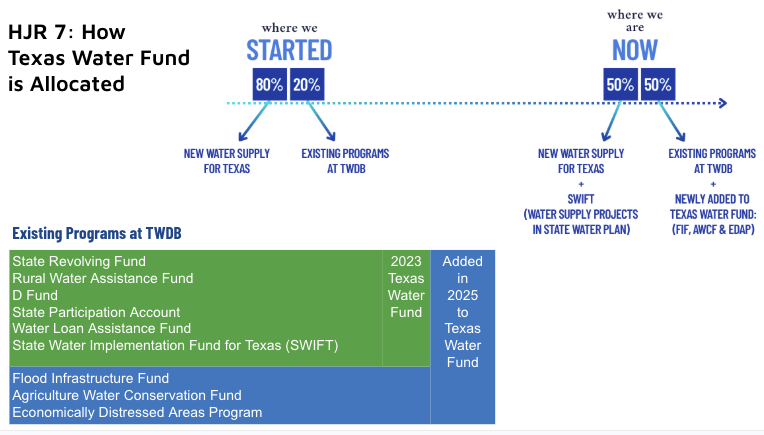
Today, Governor Abbott is expected to sign into law what promises to be the largest water investment in Texas history. Senate Bill 7 and House Joint Resolution 7 dedicate $1 billion annually for the next 20 years, beginning in 2027, split evenly between fixing existing infrastructure and developing new water supply projects.
Here is the breakdown of this historic funding:
- HJR 7 (Harris): This constitutional amendment will dedicate $1 billion annually from state sales tax revenue for the next 20 years. It must be approved by Texas voters in November 2025.
- SB 7 (Perry): This bill establishes the framework for the administration and implementation of the Texas Water Fund.
- HB 500 (Bonnen): This supplemental appropriations bill includes a $2.5 billion one-time appropriation to the Texas Water Fund for specific water infrastructure projects.
Texas faces immense challenges in securing a sustainable water supply for its communities, driven by climate change, rapid growth, and aging infrastructure. BCWK’s advocacy strongly emphasized that while new water sources are critical, we must prioritize fixing what we have before investing in something new. We strongly advocate for projects centered on water conservation through water loss mitigation and water reuse. While options like desalination, aquifer storage and recovery, and new reservoir projects may hold potential, we believe that water conservation through water reuse and water loss mitigation represent more immediate, cost-effective, and environmentally sustainable “new” water sources for Texas. These solutions are not merely conservation measures; they are vital strategies for augmenting our water supply in a state facing critical shortages.”
Our efforts this session were focused on ensuring these investments would deliver real solutions. BCWK provided detailed comments on SB 7 to advocate for expanded definitions of “new water sources” to include water reuse strategies and water loss mitigation efforts. We also supported HB 16 for its inclusion of potable water reuse projects while pushing for minimum funding thresholds for each program under the Texas Water Fund. With the City of Houston potentially needing up to $15 billion for critical repairs to its aging infrastructure, and the Texas Water Development Board (TWDB)’s State Revolving Fund programs already significantly oversubscribed, the historic investments secured this session represent a critical opportunity to support communities and utilities in need of essential infrastructure maintenance and repairs.
What These Investments Mean for Houston
The recently passed legislation, HJR 7 and SB 7, establish the Texas Water Fund, which promises $1 billion annually for water infrastructure statewide. This significant, recurring investment is administered by the Texas Water Development Board (TWDB) and will flow into various TWDB financial assistance programs. This means Houston and other entities can apply to these existing programs for projects addressing water supply, infrastructure repair, and water quality. Securing these funds for Houston will involve navigating the TWDB’s application processes and advocating for our community’s specific needs within the state’s funding priorities, which will be further defined through future rulemaking.
In addition to this long-term funding stream, HB 500, the supplemental appropriations bill, provides a significant $2.5 billion one-time appropriation to the Texas Water Fund. Nearly a quarter of this $2.5 billion is directed toward specific, pre-identified projects across the state. Many of these projects are located within the Lower Galveston Bay Watershed, signaling direct investments in our region. While we sought more localized, direct appropriations specifically for Houston region’s immense drinking and wastewater infrastructure needs, many of these broader regional investments—including numerous flood control projects—are critical and will benefit communities across our watershed that need it most.
Here is a list of supplemental appropriations for water-related projects in the Lower Galveston Bay Watershed:
Sec. 17.18. Texas Water Development Board: Direction for Specific Water Infrastructure, Flood, Wastewater, and Supply Projects and Grants Funded in House Bill 500.
(1) Unexpended balance authority remaining from appropriations made in the General Appropriations Act, 88th Legislature, Article IX, Sec. 17.42, Accumulated Siltation at Lake Houston, (estimated to be $50,000,000) is appropriated for the same purpose;
(2) $100,000,000 for Lynchburg Pump Station;
(3) $54,000,000 for Cypress Ditch Regional Flood Mitigation Project;
(9) $2,500,000 for Greens Bayou Watershed Channel Improvements;
(11) $60,000,000 for Lake Livingston Dam Improvement;
(12) $25,000,000 for Waller County Regional Stormwater Detention Basin;
(14) $2,500,000 for Aldine Westfield Storm Water Detention Basin;
(17) $10,000,000 for Lower Clear Creek Watershed Flood Project;
(18) $5,000,000 for Kingwood Diversion Ditch Improvements;
(21) $22,500,000 for Cypress Creek Watershed Flood Mitigation Project #1;
(22) $11,000,000 for Carpenters Bayou Watershed Improvements;
(23) $5,000,000 for Spring Shadows Drainage and Paving Project;
(27) $15,000,000 for City of Conroe Water Wells;
(28) $6,500,000 for West Little York Detention Basin Completion;
(32) $10,000,000 for South Mayde Creek Bypass Channel;
(33) $11,942,000 for Heather Glen Water Line Replacements;
(34) $6,000,000 for Airline Improvement District Water Infrastructure.
Losses: Missed Opportunities & Environmental Setbacks
Despite the significant water funding wins, the 89th session also saw some disappointing setbacks for environmental protection in Texas:
- HB 3728 (Morales Shaw) – This bill would have required enforceable salinity standards protecting Texas bays from desalination plant discharge. It failed to pass despite making it out of committee, a significant missed opportunity for coastal water quality.
- HB 1145 (Morales Shaw) – This bill would have initiated a study on PFAS use in hydraulic fracturing. It died in committee without receiving a hearing, leaving a critical knowledge gap about “forever chemical” contamination.
- HB 1730 (Morales Shaw) – This bill would have launched a comprehensive state study of PFAS contamination. It died after being heavily opposed by the oil and gas industry, undermining efforts to understand and address widespread chemical pollution.
- Gulf Coast Water Protection District received another $550 million for the controversial “Ike Dike” project, bringing its total allocation to nearly $1 billion. This represents a significant investment in a project whose long-term effectiveness in the face of increasing hurricane intensity and sea-level rise remains highly debated by many environmental groups and experts.
Looking Ahead: Shaping the Agenda for the 90th Legislative Session
The challenges and successes of the 89th session provide a roadmap for future legislative engagement. Our ongoing work on the ground in Houston’s diverse communities is critical, as the insights gained from direct engagement will continue to refine and shape our priorities for the 90th Legislative Session and the interim period. We are committed to advancing policies that directly address the water and flood resilience needs of our communities, building on our previous efforts and pushing for systemic change. We will continue to advocate for:
- Equitable Water Infrastructure Investment: Building on our push for dedicated state funding streams, we will advocate for policies that ensure these investments primarily target communities experiencing historic disinvestment and disproportionate impacts from aging infrastructure.
- Strengthening Water Quality & Advancing Sustainable Water Supply: Advocate for robust regulatory frameworks and improved TCEQ enforcement. Address desalination’s threat by seeking stricter salinity standards and brine discharge mitigation. Prioritize and incentivize water reuse and conservation as sustainable sources to reduce reliance on less sustainable options.
- Advancing Flood Resilience through Nature-Based Solutions: Support the State Flood Plan’s implementation, prioritizing funding for nature-based solutions like wetland protection and urban green infrastructure to reduce flood risk, especially in vulnerable communities.
- Increased Transparency and Community Participation: Push for greater transparency and accountability in environmental decision-making, including reforming water management body representation to ensure diverse community and environmental justice considerations.
What’s next? Ensuring Water Infrastructure Funds Come to Our Communities.
The work is far from over. Securing legislative wins is only the first step. Our focus now shifts to ensuring these historic investments translate into tangible improvements for Houston’s water infrastructure and communities.
- Secure Voter Approval for Billions in Water Funding: HJR 7 will appear on the November 4, 2025 ballot, asking voters to dedicate $1 billion annually from sales tax revenue for water infrastructure. If approved, this creates $20 billion in funding through 2047 with equal allocation between new supply projects and infrastructure repair.
- For Houston, this funding could address leaky pipes, improve failing water systems, and fund deferred maintenance in communities that have waited years for investment. Critical details about project selection criteria, community input processes, and environmental safeguards remain to be determined through future rulemaking. We support this funding measure while recognizing the need for ongoing advocacy to ensure implementation serves community needs rather than industry needs.
- Shape How State Water Funds are Distributed: We will continue our administrative advocacy with the Texas Water Development Board to ensure that water infrastructure funds come to our region. This summer, we’re preparing to engage with the Clean Water and Drinking Water State Revolving Funds Intended Use Plans public comment period – a big opportunity to advocate for the equitable reforms we’ve been championing and to ensure that our region sees it’s fair share of much-needed infrastructure projects. We’ll continue to push for comprehensive Disadvantaged Community Score systems, sliding scale principal forgiveness allocations, and enhanced technical assistance programs that ensure that these vital funds benefit communities that need them the most.
- Collaborate Locally for Direct Community Impact: We will continue to partner with our local government officials to make sure that our communities see these investments, especially in areas that have experienced historic disinvestment and deferred maintenance. This local collaboration is crucial for identifying specific needs and ensuring that state funds are effectively utilized to improve the daily lives of Houstonians. We are committed to supporting our local utilities in preparing competitive applications for programs managed by the Texas Water Development Board and the Texas Water Fund, maximizing their chances of securing the critical funding necessary for these vital projects.
How you can support our ongoing efforts:
- Learn more from our partners: Sierra Club Lone Star Chapter, Texas Living Waters Project, and Clean Water Action all have informative legislative wrap-ups.
- See how your representatives voted this session! Check out Texas Tribune’s interactive tool to see who voted YES or NO on major bills.
- Follow our website for updates on the SRF public comment period this summer and sign-on opportunities.
- Contact your local officials to express support for equitable water infrastructure funding and local water projects.
- Make your voice heard in November by registering to vote and voting YES on the water infrastructure constitutional amendment.
For questions about our legislative and policy work, please contact Guadalupe Fernandez at guadalupe@bayoucitywaterkeeper.org or Usman Mahmood at usman@bayoucitywaterkeeper.org.