The following blog post was written by Tai Lung, Bayou City Waterkeeper’s Senior Data Policy Fellow. BCWK partnered with PolicyLink to work with Tai, as part of a 6-month Rapid Response Fellowship, an initiative that placed former federal officials with frontline nonprofit organizations that are under threat due to policy rollbacks targeting racial, economic, and social equity.
I’ve spent most of my career working at the intersection of data, policy, and environmental justice, but the past six months have given me a new perspective.
As I wrap up my Rapid Response Fellowship, I’ve had the opportunity to be embedded at Bayou City Waterkeeper, an organization deeply rooted in protecting communities and waterways across the Houston region. My work focused on helping shape the future of their tools and data efforts, developing recommendations and practical protocols to guide how they manage and use information in support of their mission.
Before this experience, I spent more than 15 years at the U.S. Environmental Protection Agency (EPA) working on environmental justice data and mapping, where I led agency efforts on EJScreen, the agency’s publicly available, national-scale environmental justice tool. That work involved close collaboration with government partners and communities, developing indicators, shaping policy-relevant applications, and creating resources to support understanding. It was impactful and grounded in supporting communities across the country.
That work came to an abrupt end last year when the administration shut down EPA’s environmental justice office and discontinued EJScreen. Like many others, I was laid off. It was a difficult moment, not just personally, but for what it meant for the broader environmental justice landscape.
At the same time, it reinforced something important: while national tools and federal leadership matter, the environmental justice movement has never depended on them alone. Through my fellowship with Bayou City Waterkeeper, I’ve seen that reality up close.

Working within a small, community-based organization brings a clear need to prioritize and focus limited staff and resources on what will have the greatest impact. At Bayou City Waterkeeper, that includes a growing emphasis on developing tools that support communities and strengthen advocacy efforts. At the same time, like many organizations in this space, they are still working through how to most effectively use data and mapping to drive their work. In that context, the focus is not just on what data exists, but on what is most useful in informing decisions, supporting advocacy, and helping communities take action.
This experience also reinforced the importance of both national and local-level tools and how they are complementary. Both are necessary, and both are stronger when they work together.
National-scale tools establish consistency, set baselines, and shape broader policy conversations. They create a shared understanding of inequities and provide credibility that can influence decisions at the highest levels.
Local tools are where that data becomes actionable. They reflect community-specific conditions, incorporate lived experience, and support targeted advocacy. They are more nimble and better positioned to respond to immediate challenges.
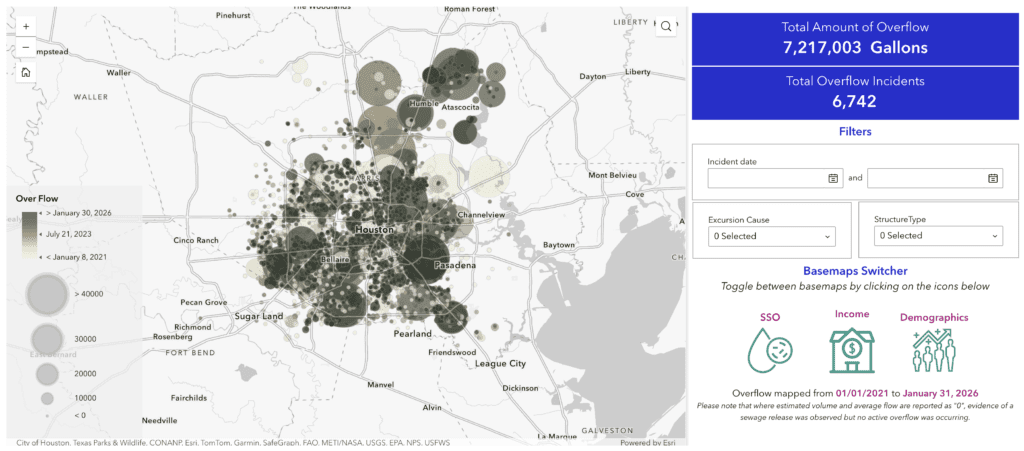
At Bayou City Waterkeeper, this approach is already taking shape through the development of locally grounded mapping tools that reflect the specific challenges facing the Houston region. Efforts like the Justice in the Sewers map draw on local sewage overflow data that is not captured at a national scale, while their wetlands mapping incorporates data specific to the Gulf Coast. These tools provide a more complete and relevant picture of environmental conditions on the ground. The central focus of my time there was helping ensure that these tools are well managed, consistently used, and aligned with the organization’s broader advocacy and policy work.
These environmental justice tools do more than present data; they equip communities with evidence. Grounded in a movement that has always been centered in grassroots community action, these tools help translate lived experience into clear, credible, and accessible information. In doing so, they become powerful resources to push back against inequities, challenge harmful decisions, and advocate for meaningful change. Data alone is not the solution, but it is an essential part of the toolkit.
This fellowship has taken place during a challenging time for the environmental justice movement. Political headwinds are real. Support for EJ initiatives has been reduced or eliminated, and some of the infrastructure that advocates once relied on is no longer available. As federal tools have been shut down, the broader ecosystem is shifting toward more state- and local-centered approaches.
Looking ahead, I’m excited to build on this experience through my leadership at the Environmental and Health Data Analysis Trust. Our goal is to help bridge the gap between data and action, ensuring that states, community-based organizations, and others have the tools and support they need to advance environmental justice in meaningful, practical ways.
This fellowship has been a reminder that impact is not just about scale, but about how effectively tools and information are put into use. The challenges ahead are real, but so is the momentum. And when communities are equipped, informed, and empowered, progress is not just possible, it is inevitable.