Bayou City Waterkeeper and our partners are calling for updated monitoring, transparent sediment testing, and stronger safeguards as the Port of Houston seeks to expand its use of an offshore disposal site.
The Houston Ship Channel is one of the most heavily industrialized waterways in the world. To accommodate massive commercial vessels and increased infrastructure, including the recent Project 11 expansion, the Port of Houston operations require constant dredging. Dredging is a process that involves removal of large amounts of sediment from the channel, and determining how that material can be safely managed requires understanding it’s physical and chemical characteristics.
Previous investigations in portions of the Houston Ship Channel have documented contaminants including dioxins and furans, PAHs, pesticides, PCBs, and heavy metals. Those findings do not mean that all sediment dredged from the channel is contaminated, but they make current, representative sediment testing an important part of decisions about where dredged material can be safely placed.
Historically, the Port of Houston and US Army Corps of Engineers (USACE) have dumped this sediment into Dredged Material Placement Areas (DMPAs). DMPAs are massive, diked land basins built to store wet dredged material right next to residential neighborhoods. Living beside a DMPA carries severe life and safety risks: levee failures threaten homes, elevated walls block natural drainage and worsen local flooding, and the sediment itself carries toxic industrial contamination.
While moving dredged sediment offshore may keep these hazardous placement sites out of communities along the Houston Ship Channel, it must not mean trading community risk for marine degradation. If sediment must go offshore, it requires the strongest possible environmental protections. Offshore disposal requires adequate sediment characterization and monitoring to understand how material behaves after placement and whether contaminants, if present, could affect marine ecosystems.
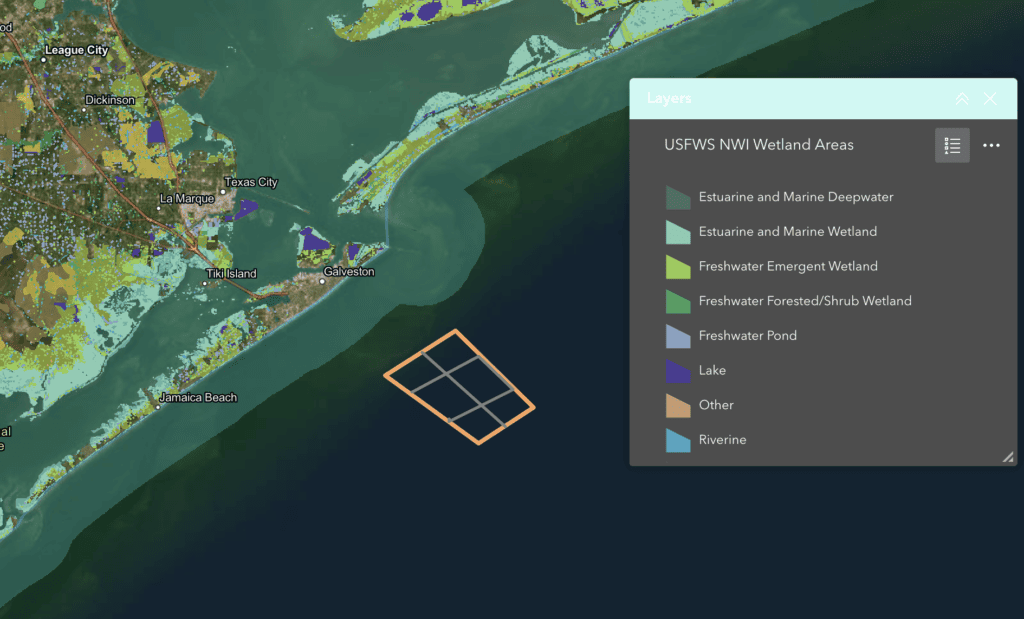
The Port of Houston Authority is seeking a federal permit to conduct maintenance dredging along approximately 52 miles of the Houston Ship Channel, from the Upper Turning Basin through Galveston Bay, and dispose of the material at the Galveston Ocean Dredged Material Disposal Site (ODMDS).
Shifting sediment offshore avoids expanding DMPAs near fenceline neighborhoods already burdened by heavy industry. However, it also raises critical ecological questions, especially as the ODMDS receives finer, potentially contaminated material from heavily industrialized stretches of the channel.
On August 27, Bayou City Waterkeeper joined Healthy Gulf, Public Citizen, Turtle Island Restoration Network, Air Alliance Houston, Environmental Defense Fund, and Galveston Bay Foundation in submitting comments to the U.S. Army Corps of Engineers. Together, we are asking the Corps to ensure that sediment testing, environmental monitoring, and public transparency keep pace with the expanded use of the site.
“Moving dredged material offshore may reduce pressure to expand placement areas near communities along the Houston Ship Channel, but it does not eliminate the need to understand what is in that material,” said Alenka Cardenas, Wetlands Policy and Outreach Specialist and Waterkeeper at Bayou City Waterkeeper. “As material from additional and more industrialized portions of the channel is considered for offshore disposal, sediment testing and environmental monitoring need to reflect both the volume and characteristics of what is being placed at the site.”
Not all sediment is the same
The Galveston ODMDS has historically received comparatively coarse, sand-dominated material. Under the proposed permit, it would receive more sediment from the upper portions of the Houston Ship Channel, where the material contains substantially more clay and silt.
That difference matters. Fine-grained sediments have greater surface area and can bind certain contaminants more readily than coarser sand. Sediment grain size therefore affects both contaminant transport and how dredged material behaves after disposal.
Previous investigations in portions of the Houston Ship Channel, including research connected to the Project 11 expansion, have documented persistent pollutants such as dioxins and furans, polycyclic aromatic hydrocarbons, pesticides, PCBs, and heavy metals.
Those findings do not establish that all material covered by this permit is contaminated or unsuitable for offshore disposal. They do demonstrate why current, representative testing is necessary for sediment from the reaches proposed for dredging.
The public notice lists two sediment reports with identical titles but different dates and federal concurrence dates. We are asking the Corps to clarify which report supports this permit and release the underlying information, including:
- Where and when samples were collected;
- Which contaminants were tested;
- What the chemical analyses and bioassessments found;
- Whether the samples represent the material expected from each channel reach; and
- How the results were used to determine that the sediment is suitable for offshore disposal.
Any additional testing conducted during the permit term should also be made available to the public.
What happens after sediment is deposited?
The Galveston ODMDS is described in its management plan as a high-energy erosional area where deposited material disperses and erodes quickly. That characteristic helps prevent dredged sediment from accumulating into large mounds that could interfere with navigation.
If contaminants are associated with fine-grained sediment, erosion and resuspension may influence how those particles move through the marine environment. Relevant questions include how far resuspended material may travel, at what concentrations, and whether existing monitoring is capable of detecting movement beyond designated disposal zones or the site boundary.
The current documents focus heavily on how quickly sediment disperses, but do not clearly explain what that movement could mean for contaminants associated with material from the channel’s more industrialized reaches.
Before expanded disposal proceeds, the Corps should explain howresuspension and transport will be evaluated and monitored.
A decade-old monitoring plan needs an update
The Site Management and Monitoring Plan (SMMP) governing the Galveston ODMDS was signed in 2016 and states that it would remain in effect for no more than ten years. That period ended in May 2026, shortly before the permit notice was published.
Federal law calls for these plans to be reviewed and revised at least every ten years. We are asking the Corps and EPA Region 6 to complete, or confirm completion of, that review and publish an updated assessment of current conditions.
An updated plan is especially important because the site may receive tens of millions of cubic yards of dredged material over time. Monitoring practices and funding should reflect that expanded volume and frequency of use.
The ecological baseline also needs attention. The most recent EPA Region 6 status-and-trend assessment cited in the existing plan was conducted in 2012, before a 2015 rule change expanded the types of Houston Ship Channel material that could be placed at the site.
Decisions about future use should be measured against current conditions, not an ecological snapshot taken more than a decade ago.
Monitoring should detect harm before it becomes severe
The existing plan establishes a tiered system in which certain findings trigger more extensive monitoring. That framework is useful, but several of its thresholds are either unclear or set too late to provide meaningful warning.
“Monitoring should be designed to identify ecological change early enough for regulators to evaluate the cause and respond,” Cardenas said. “Waiting until pollution-sensitive organisms have disappeared sets the threshold too late. Clear, measurable triggers can help identify changes earlier and make it transparent when additional investigation or management action is required.”
For example, one threshold is triggered by the absence of pollution-sensitive organisms. Waiting until those organisms have disappeared may mean that substantial ecological change has already occurred. A measurable reduction in their populations or diversity should trigger further investigation earlier.
The plan also refers to unacceptable “sub-lethal effects” on organisms living at the seafloor without defining which effects will be measured or what qualifies as unacceptable. Similarly, it references approved contaminant levels without identifying the actual concentrations the Corps will use.
Wildlife and cumulative impacts cannot be evaluated one contract at a time
The disposal site and surrounding Gulf waters support fish, shrimp, crabs, sea turtles, and other marine life. The Corps has stated that it will complete consultations required under the Endangered Species Act and the federal law governing Essential Fish Habitat before making its final permit decision.
We are asking that the results of those consultations be made public and supplemented with an analysis specific to the channel reaches and disposal zones covered by this permit. The Corps should also continue to apply the seasonal window established to protect sea turtles during hopper dredging and publicly document any exceptions.
Monitoring must also account for the site’s cumulative use. Tracking each dredging contract separately will not necessarily reveal changes developing across multiple projects over many years. The Corps should report the total volume deposited in each zone over time so that trends in sediment quality, erosion, dispersal, or mounding can be identified early.
Tracking the total volume, source reach, disposal zone, and timing of material placed at the site would provide a stronger basis for identifying trends in sediment quality, erosion, dispersal, mounding, or ecological conditions over time.
What we are asking the Corps to do
Bayou City Waterkeeper and our partners are asking the Corps to:
- Update the Galveston ODMDS Site Management and Monitoring Plan and establish a current ecological baseline;
- Release the sediment-testing data supporting the permit;
- Require ongoing, reach-specific testing for contaminants associated with finer sediment from industrialized portions of the channel;
- Explain how erosion at the disposal site could affect the movement of pollutants;
- Scale environmental monitoring and funding to the site’s expanded use;
- Establish clear thresholds that trigger deeper investigation before ecological harm becomes severe;
- Publish the results of wildlife and fisheries consultations; and
- Track cumulative disposal volumes and use of the site over time.
The question is not simply whether dredged material can be moved out of the Houston Ship Channel. It is whether that material can be managed without shifting environmental burdens from one place, and one group of people, to another.
Good dredged-material management depends on knowing what is being moved, understanding where it goes, and monitoring what happens after it gets there.
For questions about our wetlands protection and Ship Channel advocacy please reach out to alenka@bayoucitywaterkeeper.org and guadalupe@bayoucitywaterkeeper.org.