Four years ago, Bayou City Waterkeeper sparked a federal enforcement action to address the sewage pollution that has plagued the city of Baytown for years, with sewage spilling into local bayous, parks, and neighborhoods, especially during rainstorms. As with most enforcement actions across the country focused on municipal sewage pollution, this will likely end in a consent decree (a court-administered legal settlement) to make up for past neglect of Baytown’s sewage system. The consent decree will set a new baseline for infrastructure investment across Baytown over a generation and require regular updates to infrastructure to reduce water pollution and the impacts it has on residents. To be effective, these investments must target the root causes of the city’s sewage problems, especially how even small amounts of rain overwhelm Baytown’s system and create sanitary sewer overflows (the release of raw, untreated sewage from a separate sanitary sewer system).
Green infrastructure presents a solution to this problem and must be a part of Baytown’s sewage overhaul. Learn more below.
What is green infrastructure?
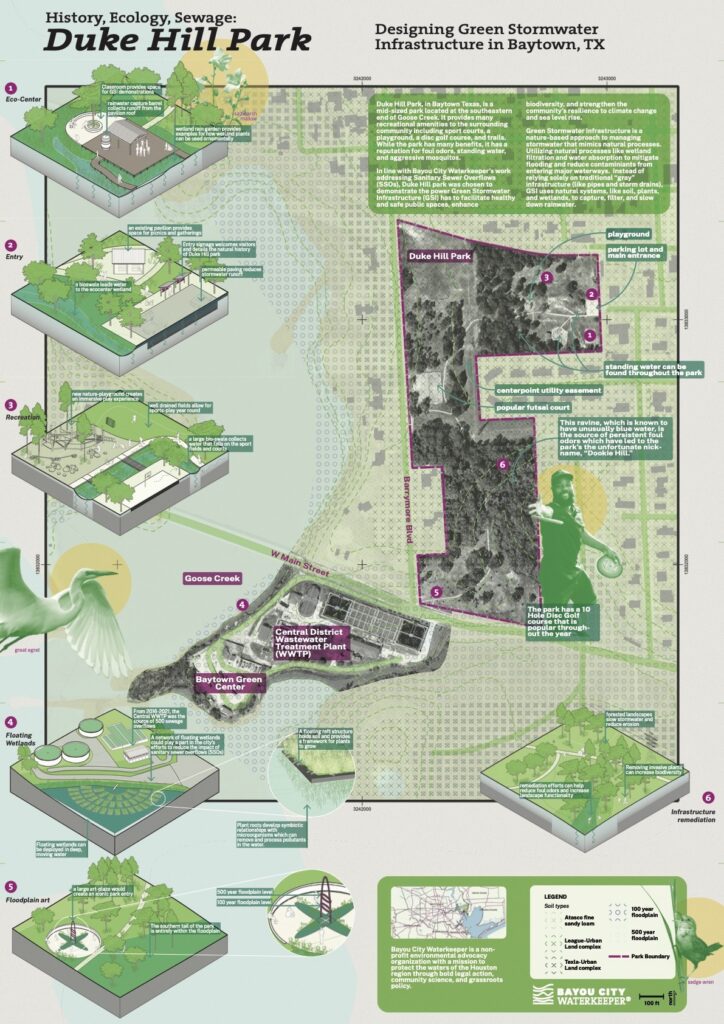
Green infrastructure (also referred to as green stormwater infrastructure, low-impact design, nature-based solutions, or nature-based infrastructure) enhances or mimics natural processes to manage influxes of water from rainstorms. Green infrastructure works across multiple scales, from site-level features like a rain garden in a front yard to larger regional systems such as restored wetland landscapes at a park. No matter the scale, the goal of green infrastructure is to slow, absorb, store, and filter water before it reaches local waterways. Green infrastructure is effective at reducing flooding and filtering out pollutants, while also delivering benefits such as improved parks, wildlife habitat, and air quality; carbon capture and urban heat reduction; and minimized erosion. While individual green infrastructure projects provide benefits on their own, the greatest impact comes from coordinating multiple green infrastructure projects with gray infrastructure (steel-and-concrete investments) upgrades across neighborhoods and watersheds. Coordination of green and gray infrastructure on a larger scale results in a more resilient sewer system.
How can green infrastructure reduce sewage pollution?
The U.S. Environmental Protection Agency has explained that in the sewage context, green infrastructure reduces the amount of water that enters the sewage system and, in turn, reduces the amount of sewage spilling out of the system without treatment. By reducing the volume of water entering and overwhelming the system during rain events, green infrastructure directly addresses the primary driver of sanitary sewage overflows (SSOs), which is system overload. At its most effective, green infrastructure complements “gray” steel-and-concrete upgrades and reduces costs overall.
One real-life example is Kansas City’s 2010 sewage consent decree, which requires green infrastructure investment across nearly 750 acres, with the aim of storing enough stormwater to reduce overflows at two major sewage outfalls. The consent decree also requires the completion of smaller-scale pilot projects to help the city understand how green infrastructure could further improve the functionality of its sewage system. It was estimated that this investment, which will occur alongside steel-and-concrete improvements, will save the city $10 million. Halfway into a 30-year implementation timeline for this consent decree, Kansas City has completed 230 green infrastructure projects. (Many of these have been mapped and documented in fact sheets along with other sewer infrastructure improvements here.)

Other smaller and medium-sized cities, like Milwaukee and Louisville, have implemented green infrastructure to more effectively address sewage overflows. The experience of these other cities shows that green infrastructure is not just a theoretical solution for Baytown. It is a proven strategy to reduce system overload and lower long-term infrastructure costs. As it plans for major sewer system upgrades under its own consent decree, Baytown has the opportunity to integrate similar approaches.
Why should green infrastructure be a part of Baytown’s sewage plan?
Bayou City Waterkeeper’s 2022 analysis of Baytown’s self-reported data showed a strong correlation between sewage overflows and rainfall. This data strongly suggests that green infrastructure could be appropriate to address Baytown’s sewage problem, alongside gray infrastructure improvements.
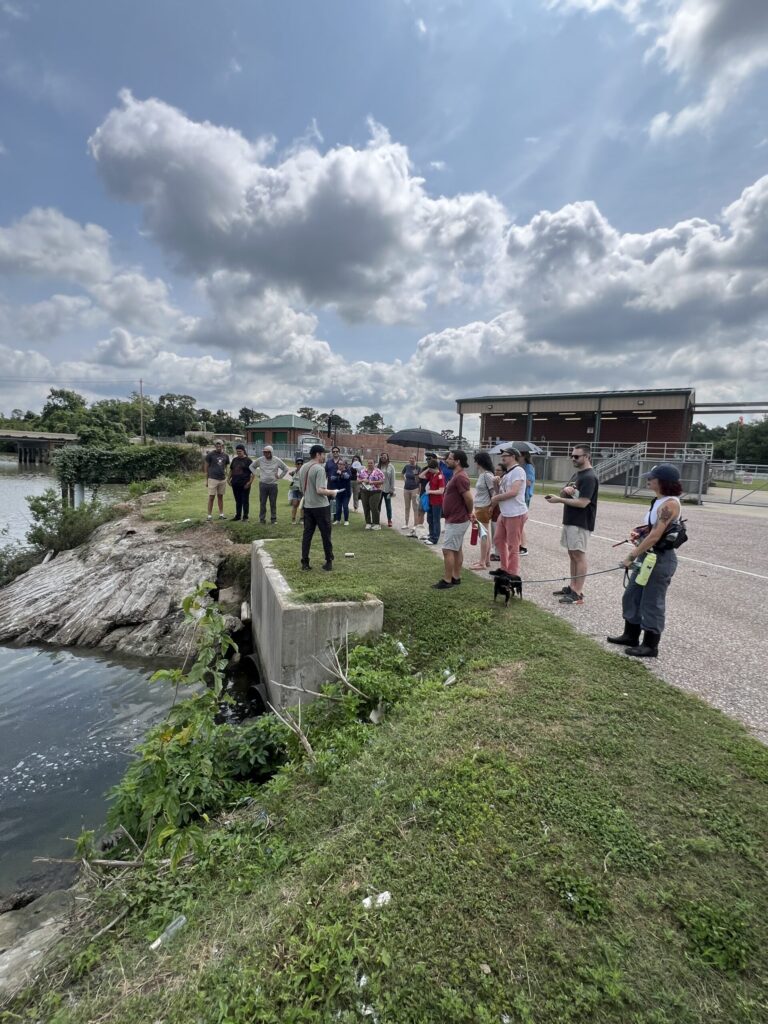
The experience of Baytown residents backs up what Bayou City Waterkeeper has observed in Baytown’s own sewage data and what Baytown has named in its own planning. First, in direct outreach and walks led by Bayou City Waterkeeper through Baytown parks, residents have expressed concern about sewage in neighborhood parks, commented on the smell of sewage that lingers in the air after even a small amount of rain, and considered how flooding in their neighborhoods contributes to Baytown’s sewage problems.
Second, community-based research, conducted over two years in partnership with Stanford University’s Woods Institute for the Environment, gathered 200 survey responses from Baytown zip codes that further grounds the conclusion that green infrastructure must be a part of Baytown’s sewage planning. These responses highlighted communities’ experience with flooding and its impacts and confirmed that “community members are broadly in favor of implementing green infrastructure and see it as a means to alleviating the effects of environmental degradation.” (Explore the findings and additional community data through Bayou City Waterkeeper’s Nature-Based Flooding Solutions dashboard.)
Last, Baytown’s own planning, reflected in the Comprehensive Plan 2040, Strategic Plan 2023–2027, and Parks, Recreation, Trails, and Open Space Master Plan, has consistently identified priorities that green infrastructure would serve, like increasing investment in critical infrastructure and parks, environmental stewardship, and improving stormwater quality.
Together, the data, residents’ experience and priorities, and Baytown’s own planning all point in the same direction: that green infrastructure must form part of Baytown’s sewer investments and consent decree planning.
Would green infrastructure be cost-effective?
The answer is yes. Consent decrees are costly for the same reason they are necessary. They make up for decades of under-investment in public infrastructure, and they represent an expense that is required and unavoidable to protect human and ecosystem health.
As noted above, the experience of other cities like Kansas City shows that green infrastructure investment can lower the costs of complying with a consent decree. Incorporating green infrastructure in Baytown’s consent decree offers another benefit: It could give the city priority access to state funding that could further reduce costs associated with meeting consent decree requirements and directly reduce the financial burden that Baytown ratepayers ultimately will bear.
The Texas Water Development Board administers our state’s Clean Water State Revolving Fund, which provides low-cost financing for a wide range of wastewater, stormwater, reuse, and other pollution control projects. When reviewing applications submitted by cities like Baytown, the Board gives higher priority and ranking to projects stemming from an “Enforcement action imposed by judicial or regulatory authorities,” like a consent decree. Green infrastructure projects also qualify cities for eligibility to receive a portion of funding in the form of subsidy or principal forgiveness.
By crafting a consent decree that allows the city to leverage external funding sources, the city can be more responsive to its sewage data, its own planning, and Baytown residents’ priorities and build the public support it needs to invest in Baytown’s future.
Want to learn more about Bayou City Waterkeeper’s work to increase green infrastructure investment in Baytown?
Check out Bayou City Waterkeeper’s tools:
- Bayou City Waterkeeper, Nature-Based Flooding Solutions dashboard
- Bayou City Waterkeeper, Wetland Mapper
Read more about Bayou City Waterkeeper’s work to advance green infrastructure in Baytown:
- Launching a Houston Flooding and Nature-Based Solutions Dashboard
- Baytown site visit & what is needed from water and environmental funders now
- Baytown’s 21 million gallon sewage problem
- What is the MS4? A conduit for cleaner water & greener communities
- Making nature-based solutions work in Houston’s Black and brown Communities
- New Proposed WOTUS Rule Threatens Wetlands and Waterways Across the Houston
Learn more about how cities across the United States have adopted a gray-green approach to mitigating stormwater and sewage pollution:
- U.S. Environmental Protection Agency: https://www.epa.gov/sites/default/files/2015-10/documents/epa-green-infrastructure-factsheet-3-080612.pdf
- San Antonio River Authority’s Green Infrastructure Master Plan: https://www.sariverauthority.org/services/sustainability/green-infrastructure/
- Kansas City Smart Sewer: https://www.kcsmartsewer.us/initiatives/kc-green-infrastructure/green-infrastructure-resources
- Philadelphia Green City, Clean Waters: https://water.phila.gov/green-city/
- NYC Green Infrastructure Program: https://www.nyc.gov/site/dep/water/green-infrastructure.page
Bayou City Waterkeeper protects the waters and people of the greater Houston region through bold legal action, community science, and creative, grassroots policy to further justice, health, and safety for our region. In Baytown, Bayou City Waterkeeper’s work focuses on addressing major sources of water pollution, identifying opportunities for elevating community priorities through infrastructure investment, and developing community leadership on issues affecting Baytown’s water and neighborhoods.